Most people think closing clients on LinkedIn is about the perfect message. It isn’t. The real difference is who you talk to and how you guide the conversation. I stopped treating LinkedIn DMs like a sales channel and started using them as a diagnostic process. That shift changed everything.
It Starts With the Right Leads
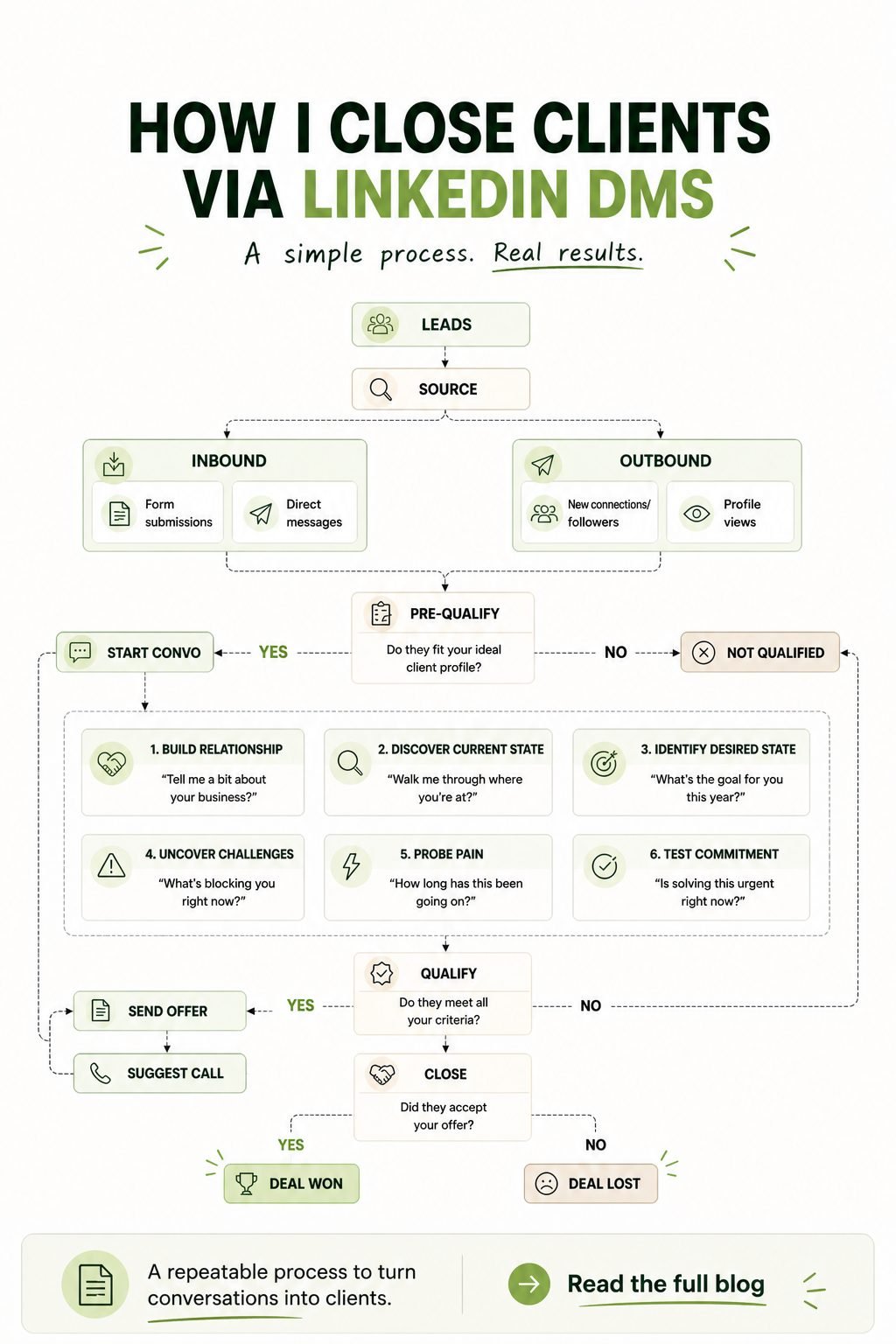
I don’t chase leads. Most of my conversations come from:
- Organic LinkedIn content
- Inbound DMs
- Form submissions
Roughly 90% of my leads are inbound. That means they already:
- Know who I am
- Have some level of interest
- Are open to a conversation
For outbound, I’m selective. I only reach out when someone clearly fits my Ideal Customer Profile. No random outreach. No “just in case” messages. Every conversation is tracked. Every follow-up is intentional. Because in most cases, deals don’t fall through — they’re simply not followed up properly.
I Don’t Try to Sell Everyone
Before I even engage, I ask myself one question: Do they actually fit my ideal client profile? For me, that usually means:
- B2B founders
- Already posting on LinkedIn
- Not seeing meaningful ROI yet
If they don’t fit, I move on. This alone saves hours of wasted effort. Trying to convince the wrong person is exhausting and it rarely works.
The Conversation Doesn’t Start With a Pitch
When I reply to someone, I don’t jump into what I offer. I ask something simple: “Tell me a bit about your business.” That’s it. No pressure. No agenda. Just curiosity. Because people open up when they feel understood not when they feel sold to.
Understanding Their Current Reality
Once the conversation starts, I focus on context. I want to know:
- What’s working for them
- What isn’t
- What they’ve already tried
Without this, everything becomes guesswork. With it, patterns start to emerge. You start to see where things are actually breaking.
Clarifying Where They Want to Go
Then I shift the conversation slightly:
- What’s the goal?
- What does success look like for them?
This step is underrated. Because if someone can’t clearly define where they want to go, they’re not ready to invest in getting there. Clarity creates momentum.
Finding What’s Really Blocking Them
Now we get to the real problem. Not the surface-level issues — the actual blockers. I ask questions that help them think deeper:
- What’s stopping progress?
- Where are things breaking down?
- What’s frustrating them most?
Most people don’t fully understand their own challenges until they’re guided through them. And once they do, the conversation shifts. It becomes less about “interest” and more about need.
Measuring Urgency
Not every problem is worth solving immediately. So I ask: “How long has this been an issue?”. This tells me everything. If it’s been ongoing:
- It’s painful
- It’s important
- It’s likely a priority
If it’s new:
- They might still be exploring
- They’re not ready to commit yet
And that’s fine. Not every conversation needs to convert today.
Testing Commitment
At this point, I need to understand one thing: Are they ready to solve this now? Because without urgency, there’s no decision. If it’s not a priority, I don’t push. I let the conversation stay natural.
Only Then Do I Talk About the Offer
This is where most people go wrong. They pitch too early. I wait until:
- The problem is clear
- The goal is defined
- The urgency is established
Only then do I say: Would you like me to walk you through how I can help? Sometimes I send details. Sometimes I suggest a call. It depends on the situation. But by this point, I’m not convincing them anymore. I’m helping them move forward.
Closing (Or Learning)
There are only two outcomes: They say yes. Or they don’t.
If they say yes — great. If they don’t, I don’t treat it as a loss. I look at:
- What held them back
- What questions came up
- Where the hesitation was
Every conversation becomes feedback. And that feedback improves:
- My targeting
- My messaging
- My content
The Shift That Changes Everything
Most people approach LinkedIn DMs like this: How do I sell better? But the real question is: How do I understand better? Because when you truly understand:
- The person
- Their problem
- Their urgency
The sale doesn’t feel forced. It feels like the next logical step.
Final Thought
You don’t need better scripts. You don’t need more messages. You need a better process. One that focuses less on pitching and more on diagnosing. That’s what turns conversations into clients.
To support businesses implementing this strategy, we’ve created a dedicated tool. You may explore it to see how it aligns with your objectives @ https://www.lynkread.com/contact-us